Rules of Golf: Beginner's Guide
Learn the fundamentals of golf with structured, easy-to-follow chapters
Chapter 10
Scorecards & How to Write Scores
Understanding how to use a scorecard correctly is essential for tournaments and tracking your progress. Let's break down everything you need to know.
What Is PAR?
PAR is the recommended number of strokes a skilled player should use to complete a particular hole. It serves as a "standard" to compare your own score-whether you played better, worse, or exactly as expected.
Typical PAR values:
- 3: If a hole is PAR 3, a skilled player should complete it in three strokes-one shot to reach the green and two putts.
- 4: If a hole is PAR 4, a skilled player should complete it in four strokes-one tee shot, one shot to reach the green, and two putts to hole the ball.
- 5: If a hole is PAR 5, a skilled player should complete it in five strokes-usually one tee shot, two longer shots to approach the green, and one or two putts to hole the ball.
What Is a Scorecard?
A scorecard is a document used to record your scores during a round of golf. It contains important information about the course and your performance.
📱 Paper and digital scorecards: Nowadays scorecards come in both paper and digital form - most golf clubs and federations use mobile apps (such as the LGF app) where scores can be entered on your phone and go straight into the handicap system.
Key Information on a Scorecard:
- Hole Number: 1 - 18
- Par: Expected strokes for each hole
- Stroke Index (SI): Hole difficulty ranking (1 = hardest, 18 = easiest). Determines where you receive handicap strokes
- Distance: Length of each hole from different tees
- Your Score: Actual strokes taken (gross score)
- Net Score: Gross score minus handicap strokes (calculated after the round)
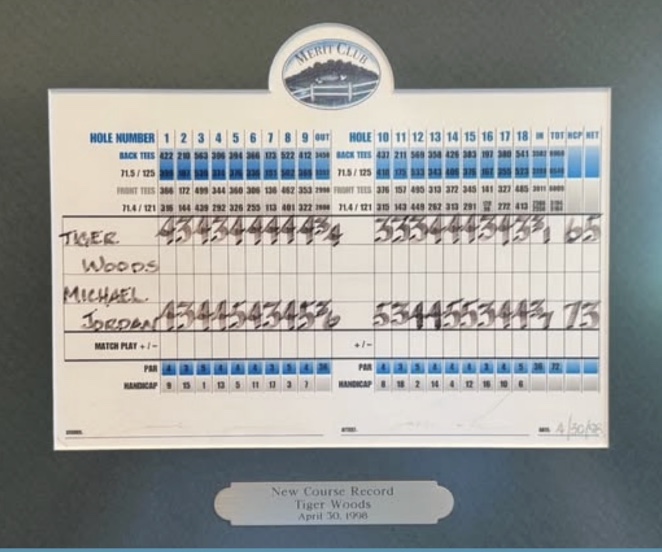
Example of a completed golf scorecard
Exchanging Scorecards
⚠️ CRITICAL RULE:
You NEVER keep your own score in tournament play. You are responsible for marking another player's score, and they mark yours.
How It Works:
- You keep the scorecard of another player in your flight
- They keep your scorecard
- After each hole, tell your marker your score
- Your marker writes down your gross strokes
- At the end of the round, both you and your marker must sign the scorecard
❌ Failure to sign = Disqualification (DQ)
Announcing Your Ball
Before starting your round, announce your ball to your playing partners:
Example: "I'm playing a Titleist Pro V1, number 3, with a red dot."
This helps avoid confusion if multiple players hit similar balls. Playing the wrong ball results in a penalty!
Who Tees Off First?
🏁 First Tee
Determined by lottery (drawing cards/tees) or assigned on the tee time sheet. In casual play, players often volunteer or decide among themselves.
🏆 After Hole 1 (Tournament Play)
The player with the lowest score on the previous hole has "honors" and tees off first. If scores are tied, the player who had honors on the previous hole keeps it.
🏌️ Casual Play
Players may choose freely or use "ready golf" (whoever is ready plays first, as long as it's safe).
Recording Scores Correctly
✅ Correct Scoring:
- Record only gross strokes (actual number of shots taken)
- Double-check the score after each hole
- Do NOT calculate net scores or Stableford points on the course (officials do this)
- Write clearly and legibly
⚠️ Wrong Score Rules:
- Score too low: Disqualification (DQ)
- Score too high: The higher score stands (you're penalizing yourself, but it's valid)
📝 After the Round:
- Review all scores with your marker
- Both player and marker sign the card
- Return the scorecard to tournament officials immediately
- Do NOT leave the course until your card is submitted
Test Requirement: You need to score at least 80% (4 of 5) to complete this chapter.
Each test has 5 questions. Pass with 80% or higher to mark the chapter as complete.